

Ideal lead arm movement patterning has been a major topic of discussion in the baseball community, but should it be?
I didn’t start pitching until my senior year of high school, imagine that, a converted catcher with no clue what I was doing whatsoever, but got up there and threw as hard as possible.
With that being said, I’ve heard countless interpretations of lead arm action in my playing and coaching career, from the popular “glove to chest or armpit” to “pulling the glove toward the hip”.
Too often movement patterns are overloaded with cueing one way or another, resulting in breakdown in movement efficiency and loss of “unique” biomechanical sequencing.
Let’s get into the concept of positive disconnection and how it is influential in lead arm sequencing, common glove arm patterning methodologies, and how to instill efficient movement patterning of lead arm.
Connected or Disconnected?

Take a look at the video above…99.0 mph Fastball from the “Cuban Missile” Aroldis Chapman sawing off Ryan Flaherty of the Baltimore Orioles.
First thought for most of you watching this video or the freeze frame of the same video below is somewhere along the lines of: “He’s pulling his glove arm”.
Positive Disconnection can be described best as:
Utilizing the glove arm to retract the lead scap in uni-son with the scap retraction occurring on the throwing-arm side, creating thoracic spine extension and a “big chest.”
Hacking the Kinetic Chain – Driveline Baseball (Pg. 29)
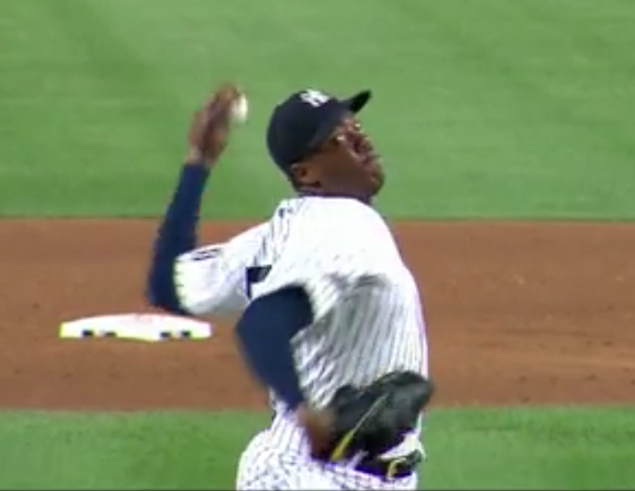
It has become apparent in high velocity “throwers” on and off the mound, exhibit extensive horizontal abduction of the throwing shoulder, in turn, display similar ROM in the lead arm as seen in the above image.
Things to highlight in this still of Aroldis Chapman:
- Elite Level Degree of Throwing Shoulder Horizontal Abduction
- Front Shoulder remains “Closed” and Directional toward Home Plate
- Elite Level Degree of Glove Arm Shoulder Horizontal Abduction
- Displays “Big Chest” prior to transition into Max External Rotation
- Head in Neutral Position prior to Rotation of the Upper Half
Glove arm goes through full range of motion before max external rotation of the throwing shoulder has been reached before the “Driveline Phase” or in simple terms, the transition from external rotation to internal rotation into ball release.

Think of positive disconnection as creating an efficient pathway for the torso and throwing shoulder to rotate in toward the desired target.
This is an extremely intricate collection of movement patterns with the goal of producing a high velocity and efficient throwing sequence. Execution requires an enhanced level of proprioception, or in simple terms, controlling individual extremities in a codependent and independent manner.
“Old School”

How many times have you heard a coach say, “Bring your Glove to your Chest” or “Glove to the Armpit” when referring to lead arm sequencing?
This is a prime example of a result based approach to patterning the glove arm, regardless of position.
Now Rob, why is this cueing inefficient and potentially detrimental to lead arm action?
First and foremost, will full range of motion of the lead arm ever truly run its course? Unfortunately, forcing a movement pattern in this manner restricts how efficient the torso and throwing shoulder rotate in a directional manner.
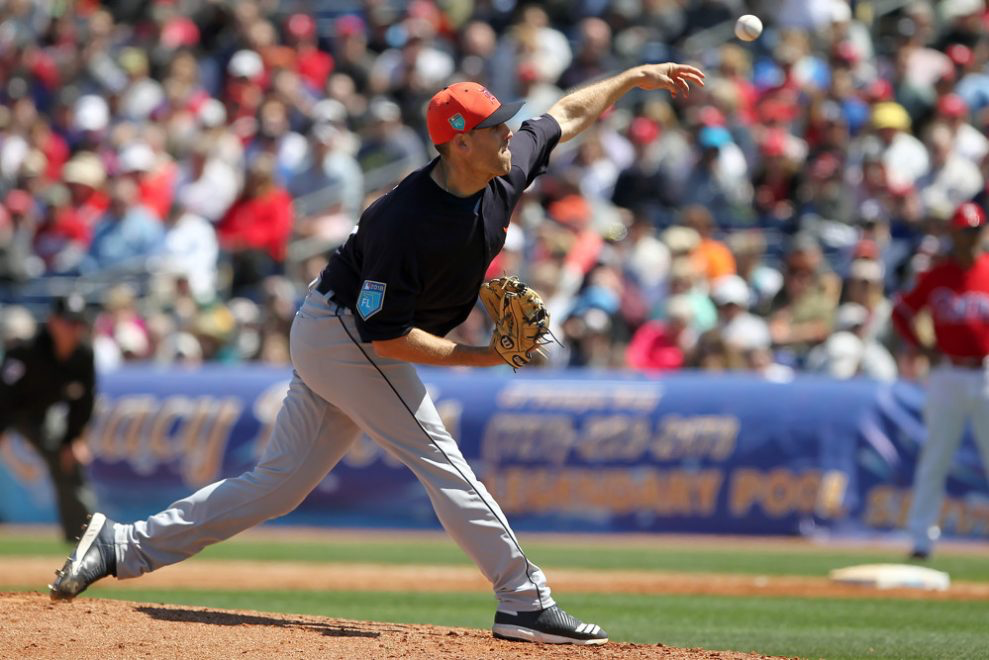
Typically the lead arm finishes range of motion in a position somewhere underneath the armpit with varying degrees of height, flexion, or extension of the arm.

Look at this screenshot of a Tom House pitching video, a popular instructional video, forcing lead arm movement patterning to “stay out front” and “remain out front” utilizing a towel drill. Range of motion is abruptly stopped with result oriented cueing.
Don’t get me started on towel drills and how they don’t match kinetic checkpoints in a throwing motion, proven by biomechanical analysis by Driveline Baseball, but I’ll save that for another day.
Try this perspective on for size.
Think of lead arm sequencing as a direction of force. For an athlete’s torso and throwing shoulder to apply force directionally, and maximize range of motion in an efficient manner, should your glove and lead arm stay in that pathway?
(Lead Arm + Glove) + Placed in Direction of Force = Premature Deceleration
Takeaways

Overload of information dissecting lead arm movement patterns in a short blog post, now what?
Let’s recap what we know about efficient lead arm sequencing:
- Front Shoulder and Lead Arm Work Independently
- Horizontal Shoulder Abduction of Lead Arm is Essential for Positive Disconnection to Occur
- Front Shoulder Remains on Target for as Long as Possible
- Lead Arm and Glove Clear to Allow Efficient Rotation of the Torso and Throwing Shoulder in Direction of Target
- Full Range of Motion of Lead Arm concludes before Driveline Phase
Positive Disconnection is a highly advanced movement requiring high levels of proprioception to execute correctly. Do I suggest coaches attempt to cue positive disconnection in their amateur athletes with no prior experience? Absolutely not.
Without a process of trial and error and video analysis, having a clue what you’re looking at in each individual athlete, more harm than good can come of the process and ultimately hinder athlete performance.
Want to talk shop about cueing movement patterns in athletes? Please shoot me and email below, we all are constantly learning, knowledge is endless.












































 Essentials of Baseball Development