

It’s crazy to think how much the structure of baseball development has changed over the last two decades, especially off the field. Strength in the weight room was never a priority early in my career; it’s funny to look back and think that I didn’t start getting after it in the weight room until I was in college…
I developed as an athlete in a world dominated by the idea that “Baseball Players Don’t Lift”, just think about that for a second.
Skill Specific development came first and foremost in every training environment I was ever involved with prior to college, and it’s crazy to think that more often than not the same is true today.
Putting that in perspective, going into my freshman year of college I was consistently upper 80’s on the mound. A few months later, I was 90-93 touching 94+ in game pitching for Franklin Pierce University. Now how did this increase of velocity happen?
- Zero Weighted Balls
- Frequent Long Toss
- Resistance Band Exercises
- Team Conditioning
- Strength Development
- 15.0 +/- LB Body Weight Increase
Strength Matters. The number one focus of athlete development in all sports should be strength, especially in baseball.
Just when your body has all the answers, you have to change the questions.
-Louie Simmons, Founder Westside Barbell
The System
The Conjugate System is based on three distinct methods of training, working collectively to improve athletic performance:
- Maximum Effort
- Dynamic Effort
- Repeated Effort
Training frequency is traditionally a four day minimum, adaptations of frequency can be made accordingly. The four training sessions are split into a focus of upper and lower body, utilizing both maximum and dynamic effort lifts.
Implementing this system into my own personal training and my clients programs has been absolutely revolutionary; the conjugate system has made me question everything I know about strength & conditioning, the results speak for themselves and are impossible to ignore.
Want to take your strength to a whole other level? Let’s get into it.
Maximum Effort

When it comes to sports performance, force production is and always will be king. The bigger, stronger, faster the athlete more potential for success on the playing field.
Maximum Effort strength protocols improve sports performance in a multitude of ways:
- Enhanced Muscle Neuron Recruitment
- Intermuscular Coordination
- Intramuscular Coordination
- Proprioception
- Physiological Adaptations based on External Load
Athletes Are In A Constant War Against Gravity…
The Max Effort Method Then, Is Our Greatest Weapon In That War..
-JJ Morris, StrongEight
Maximum Effort training is a structure of single attempts post warmup until reaching a new max or personal record, volume is a collective of progressive increase in weight not repetitions.
This concept is something I struggled with in college, receptions with always progressive, based on traditional strength training periodization. Hence why my max deadlift was 495.0 for years, until I adopted conjugate based programming and just a few weeks later I was pulling 545.0+ at a 2+ inch deficit…
Typical Maximum Effort Exercises include some of the following:
- Box Squat (Low, High, Sumo, Zercher)
- Deadlift (Sumo, Conventional, Rack Pull, Deficit)
- Good Mornings (Arched Back, Seated, Conventional.) *Never Less Than 3 Repetitions*
- Floor Press (Close/Medium/Wide, Dumbbell)
The primary focus when determining maximum effort exercise selection should be what the athlete is weak in, building a complete athlete as a whole trumps huge numbers in one exercise and subpar in multiple. Also, variation of exercise is important due to the law of accommodation, but we will get into that later on.
Dynamic Effort

Dynamic Effort or in simple terms, Speed Work, is a powerful tool when emphasizing rate of force production in athletes.
The concept of Dynamic Effort is training with sub-maximal loads at maximal velocity. Think of it this way:
(Sub Maximal Load + Maximal Velocity) = Increased Rate of Force Production
One of the major components of the Dynamic Effort Method is the implementation of Accommodating Resistance.
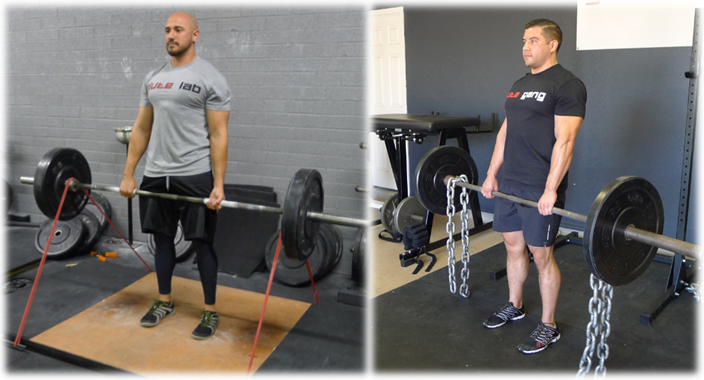
Accommodating resistance enhances the “Stretch Reflex”, the concept that our skeletal muscle creates elastic energy just like a rubber band through the distribution of tension and elongation of the muscle.
Moving sub maximal weight with accommodating resistance enables increased motor neuron recruitment to eliminate and work against bar deceleration typically around 25% at max tension of band at the height of a deadlift/squat/bench press.
This brings us to the concept of Reversal Strength, the utilization of overspeed eccentrics using accommodating resistance to create increase in kinetic energy. Simply put, accommodating resistance forces the external load down faster than the weight + gravity alone, forcing physiological adaptation to given stimulus.
I could go into the force velocity curve and how the conjugate system uses a physics based approach to baseball development, but I’m going to stick to the basics in this post and save it for another day and not overload you with information.
“The Big Leaguers of the early 2000’s weren’t juicing for better mechanics…
-JJ Morris, StrongEight
Repeated Effort

Training volume management is a simple in conjugate based training programs, with a majority of the total volume coming from Repeated Effort.
“Size, strength endurance and restoration can all be achieved through implementation of the repetition method. It is a simple, yet highly effective way to raise work capacity and volume to increase a lift total.”
– Westside Barbell
From a programming standpoint, if a strength focus is emphasized, moderate to heavy load exercises with focus on the posterior chain and abdominals will be the primary prescription.
If an explosive component is of focus, loaded and unloaded jumps, bounds, and depth jumps will be a primary component of an athletes programming on a maximal or dynamic effort day.
Typical Repeated Effort exercises include some of the following:
- Sled Pulls (Forward, Backward, Lateral)
- Resistance Band Tricep Extension (100+ Reps)
- Dumbbell Press
- Weighted Box Jumps
- Bent-Over Rows
Program Structure
PR 475.0 LB Box Squat
January 7th, 2019
The Conjugate System, from a programming standpoint, is simple yet extremely effective with any athlete population, especially baseball players.
A typical training week for an athlete, or in this case baseball player, is broken up into a four day training split.
- Day One: Lower Body (Maximal)
- Day Two: Upper Body (Maximal)
- Day Three: Lower Body (Dynamic)
- Day Four: Lower Body (Dynamic)
As mentioned earlier, for Maximal Effort lifts, up to 4-5 or more exercises are rotated weekly to prevent physiological accommodation, or in simple terms, creating variable stimulus on a daily training basis.
Maximal Effort Movement are progressive to a 1 rep max; Post warmup, working up to a PR (Personal Record) lift in sets of one, increasing weight with each set. *Good Morning variations never should be done less than 3-5 repetitions*
Dynamic Effort Movement programming is set up differently than Maximal in numerous ways, here’s an example of a Lower Body Dynamic prescription from Westside Barbell:
- Choosing Any Form of Box Squat
- Adding Load of 50% of 1RM in Week 1, 55, and 60% in Weeks 2 and 3
- Adding 25% of Accommodating Resistance in Bands or Chains *70%,75%,80% of 1RM if no accommodating resistance is available*
- Perform 10 Sets of 2 Reps at Maximal Speed, with 45 sec rest periods
- Following Box Squat protocols, working right into Speed Deadlifts
- Performing 6-8 sets of 2 Reps with 50% of 1RM with additional 25% of Accommodating Resistance *65-70% of 1RM if no accommodating resistance available*
For Upper Dynamic Effort, the same template applies but a few slight adjustments:
- Choosing Any Form of Bench Press
- Adding Load of 50% of 1RM in Week 1, 55, and 60% in Weeks 2 and 3
- Adding 25% of Accommodating Resistance in Bands or Chains *70%,75%,80% of 1RM if no accommodating resistance is available*
- Perform 9 Sets of 3 Reps at Maximal Speed, with 45 sec rest periods
- Variation of Grip every 3 Sets if applicable; Narrow/Normal/Wide
Following Maximal and Dynamic Effort Primary Movements, speciality exercise movement is the next piece of the prescription.
Choice of 2-3 movements of 5-8 various exercises both strength and explosive based movements to strengthen weak points or promote velocity, given selection being individually programmed.
Each workout concludes with a dose of specific posterior chain and core exercises designed for injury prevention; For example: Reverse Hyperextensions and Dumbbell Side Bends along with others.
Takeaways

The Conjugate System developed by Westside Barbell is revolutionary in the strength and conditioning world, taking athletic performance to new heights.
Baseball In-Gym and Remote Clients of mine have seen major performance improvements over the past year using Conjugate System based programs resulting in:
- 6+ All-Conference and/or All-State Baseball Selections
- Multiple 100.0+ mph Exit Velocities
- Numerous 90.0+ mph Pulldown Velocities
- Multiple 450+ lb Box Squat and Deadlifts
- Numerous 20+ lb Offseason Weight Gains
I couldn’t be more proud of the work my clients have put in over the past year, I am blessed to work with so many athletes with an unmatched work ethic; it’s awesome seeing them show out on the field. The goal isn’t to build better athletes..it is to build monsters.
As coaches, we strive to help our athletes reach levels we never could, make them better than we ever were.
But Rob, how is this different from traditional strength programs?
For example, traditional progressive periodization in strength and conditioning consists of structured phases:
- Stabilization Endurance
- Strength Endurance
- Hypertrophy
- Maximal Strength
- Power
The problem with traditional periodization in the strength and conditioning world can be summed up in one word; inefficient.
With the variation of program focus every few weeks, loss of performance in any given phase begins to show after a few weeks. Baseball players cannot afford to lose force production in ideal planes of motion and cannot afford to lose muscle gains during the season, resulting in decreased performance on the field.
For the Average Joe, more often than not, is progressive to reaching his physical goals with the basic structure of progression because performance isn’t a priority.
Baseball Players rely on maximal levels of force production on the field, whether that be hitting, throwing, fielding, and running to produce at an elite level. Force production is King.
With that in mind, if force production is king…wouldn’t your training program reflect that concept?
Keep in mind here folks, there is so much more to the Conjugate System that I didn’t cover in this post, especially the science and physics behind the methodology.
Do yourself a favor and follow the following on social media for everything Conjugate System:
- @strongeight Coach JJ Morris, StrongEight, Specializes in Baseball Performance
- @westsidebarbellofficial Westide Barbell, the origin of the Conjugate System and Louie Simmons
- @queenbeepower Laura Phelps, one of the strongest women you’ll ever see…ever
- Join the Conjugate Club, Westside Barbell’s online portal of endless information
“The directions and planes of force production, play a crucial role in the development of velocity”
– JJ Morris, Strong Eight
Featured Sources:
The Westside Barbell System For Sports : Westside Barbell
Conjugate Club Baseball : Coach JJ Morris
 Essentials of Baseball Development